
"Translating Regeneration into Life"
Document Type : Original Article
Authors
1 Department of Orthopedic Surgery, TeMS.C., Islamic Azad University, Tehran, Iran.
2 Department of Orthopedic Surgery, School of Medicine, AJA University of Medical Sciences, Tehran, Iran.
3 Department of Hematology, School of Allied Medical Sciences, AJA University of Medical Sciences, Tehran, Iran
Keywords
Introduction
Allogeneic packed red blood cell (PRBC) transfusion is a standard procedure during major orthopedic surgeries, including total hip arthroplasty, to control bleeding [1-4]. However, in addition to the known acute risks, there is accumulating evidence that allogeneic blood may alter the recipient’s immune system through a process called transfusion-related immunomodulation (TRIM) [1-5]. The clinical effect of TRIM varies depending on the particular circumstances of each patient. Although immunosuppression may be beneficial for organ transplantation, it is generally disadvantageous in orthopedic surgery [1–5, 6-9]. Existing data suggest that TRIM may increase the risk of post-operative complications such as surgical site infections and delayed tissue healing by shifting the immune response from a pro-inflammatory state to an anti-inflammatory profile [3–5, 8-10]. This immunological shift is due to a balance of various cytokines. Interleukin-1 (IL-1) serves as a critical mediator of the early inflammatory response, while interleukin-10 (IL-10) functions as a potent anti-inflammatory cytokine involved in regulating and suppressing the immune response [1–3, 8, 9, 11]. If a shift towards the IL-10-dominant profile occurs during the post-operative period, this could potentially impair the host immune response and compromise both infection control and tissue repair [8, 9, 11-13].
Since the balance between IL-1 and IL-10 may determine the post-operative immune response, examining their perioperative changes may shed light on the immunological effects of transfusion. In this study, we aimed to examine the perioperative changes in serum IL-1 and IL-10 levels following perioperative treatment in patients undergoing primary total hip arthroplasty. By comparing patients who received allogeneic PRBC transfusion with non-transfused peers, we sought to determine whether transfusion is linked to altered immune homeostasis during the early post-operative period.
Materials and Methods
Study design and participants
This is a prospective comparative study. We enrolled 70 patients who were scheduled for elective primary total hip replacement. They were divided into two groups matched for sex according to their need for intraoperative transfusion: Transfusion group (n=35; patients who received an allogeneic PRBC transfusion) and control group (n=35; patients who did not receive any blood transfusion during the perioperative period). Inclusion criteria were: Age 20–65 years, preoperative hemoglobin >10 g/dL and hematocrit >30%, and no allogeneic blood transfusion in the preceding three months. Exclusion criteria were active infection or inflammatory disease, autoimmune disorders (e.g. rheumatoid arthritis, systemic lupus erythematosus), current or recent use of corticosteroids, chemotherapy, or other immunosuppressive agents; history of malignancy, hematologic disease, or chronic renal/hepatic insufficiency; need for extra blood components (platelets or fresh frozen plasma), and documented allergic reactions to prior transfusions. To minimize variability related to storage lesions, each patient in the transfusion group received one unit of allogeneic PRBCs obtained from a national blood bank, and the units were used at approximately 20 days post-donation. The transfused units were non-leukoreduced and unprocessed.
Sample collection and processing
Five milliliters of peripheral venous blood were collected at three time points: T0 (15 minutes before surgical incision), T1 (24 hours after surgery), and T2 (7 days after surgery). Samples were centrifuged at 3000 rpm for 10 minutes, and serum was separated, aliquoted, and stored at -70 °C. In order to minimize inter-assay variation, all samples were analyzed in a single batch, and repeated freezing/thaw cycles were avoided [14].
Cytokine quantification
The serum concentrations of IL-1 and IL-10 were determined using high-sensitivity sandwich ELISA (enzyme-linked immunosorbent assay) kits (R&D Systems, Minneapolis, MN, USA) according to the manufacturer’s instructions. The serum samples were loaded into microplates pre-coated with the relevant antibodies. After incubation and washing to remove unbound proteins, the enzyme-linked detection antibody was added. After a second incubation, the plates were washed again, and color development was started using the substrate solution [14]. The reaction was then terminated, and the optical density was measured at 450 nm by a microplate reader (HumaReader HS, Wiesbaden, Germany). The standard curve for each test was used to calculate cytokine concentrations. To ensure accuracy, all samples were analyzed in triplicate, and the mean values were used for the statistical analysis.
Statistical analysis
Statistical analysis was performed in SPSS software, version 26 (IBM Corp., Armonk, NY, USA). The continuous variables were described as Mean±SD or median (range), and the categorical variables as number (percentage). The Shapiro-Wilk test was used to determine whether the data distribution was normal. Between-group comparisons were performed using the independent samples t-test for normally distributed continuous variables, the Mann–Whitney U test for non-normally distributed continuous variables, and the chi-square test for categorical variables. Changes over time in each group were evaluated using repeated-measures analysis of variance (ANOVA) followed by a post-hoc test. Also, using Pearson’s correlation test, the relationships between IL-1 and IL-10 levels were assessed. Statistical significance was set at 0.05.
Results
Demographic and clinical characteristics
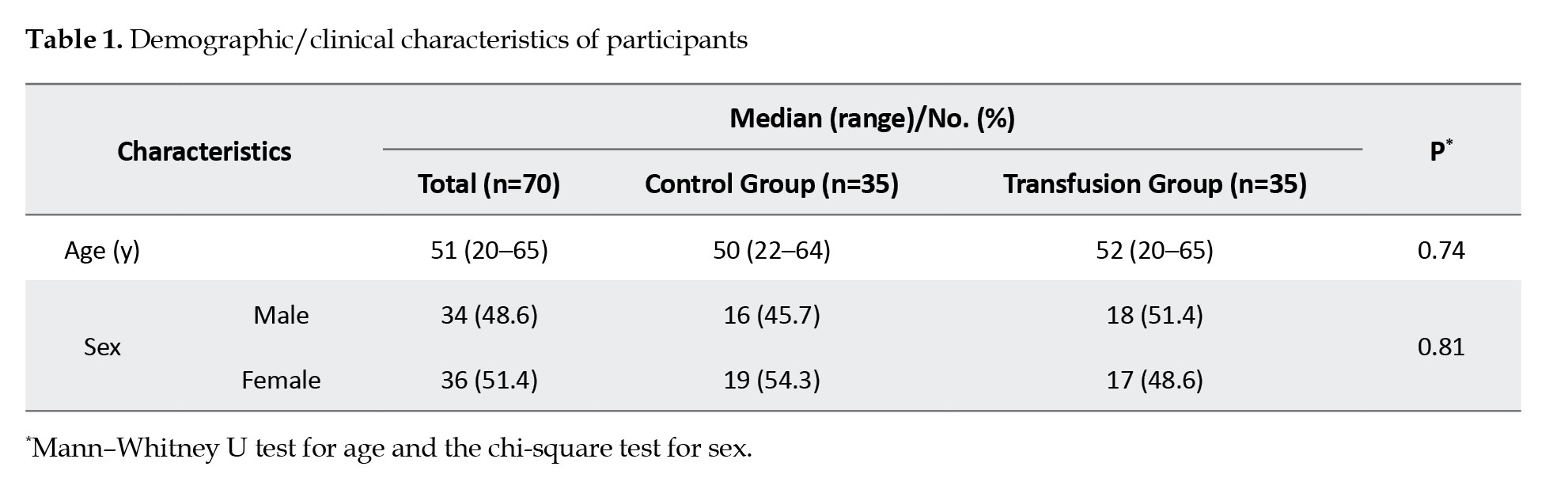
The study included 70 patients undergoing primary total hip arthroplasty, divided into the transfusion Group (n=35) and the control group (n=35). Both groups were matched for age, gender, and duration of surgery, with no significant differences in baseline characteristics (P>0.05) (Table 1).
No perioperative complications associated with the study procedures were observed, and all patients fulfilled the study protocol.
Longitudinal analysis of IL-1 level
At baseline (T0), there was no significant difference in serum IL-1 level between the transfusion (77±8 pg/mL) and control (81±6 pg/mL) groups (P=0.68). Significant differences were observed in both groups post-operatively. In the control group, IL-1 levels increased gradually from 165±12 pg/mL at T1 to 273±28 pg/mL at T2, which is higher than the baseline values (P<0.001). In the transfusion group, IL-1 levels increased to 178±15 pg/mL at T1 and then significantly declined to 141±16 pg/mL at T2 (P<0.05; Figure 1A).
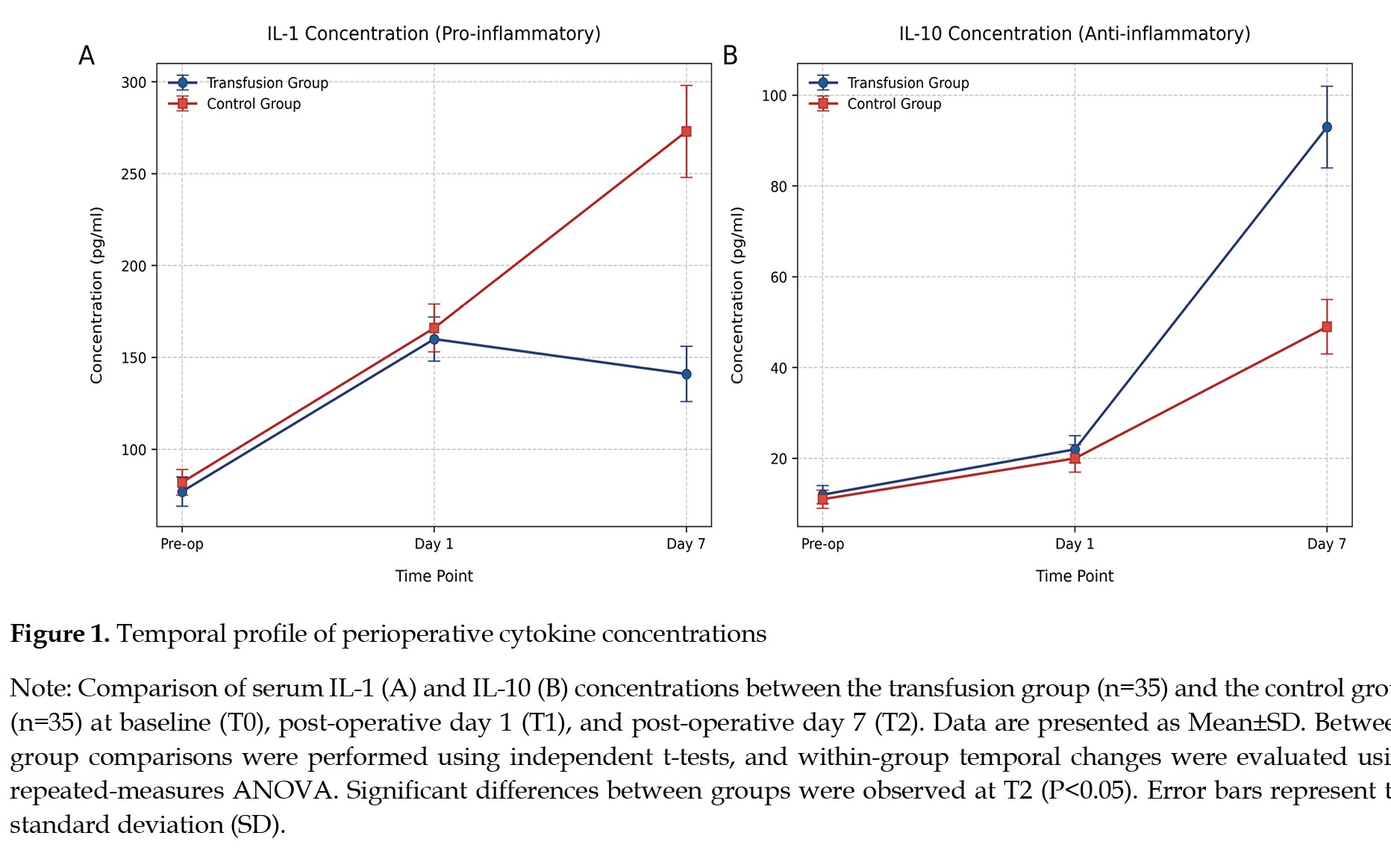
A comparison between the two groups did not show a significant difference in IL-1 level at T1 (P>0.05). However, at T2, IL-1 levels were significantly higher in the control group than in the transfusion group (273±28 vs 141±16 pg/mL, P<0.01), almost twice as high as in the transfusion group.
Longitudinal analysis of IL-10 level
At baseline (T0), there was no significant difference in serum IL-10 level between the transfusion (24±5 pg/mL) and control (25±6 pg/mL) group (P>0.05). Significant differences were observed in both groups post-operatively. In the control group, IL-10 levels increased significantly to 49±7 pg/mL at T2 compared to T0 (P=0.042). In the transfusion group, IL-10 levels increased to 35±6 pg/mL at T1 and further increased to 93±9 pg/mL at T2, representing a 3.8-fold increase from baseline (P<0.001; Figure 1B). The comparison between the two groups showed that IL-10 concentration was significantly higher at T2 in the transfusion group compared to the control group (93±9 versus 49±7 pg/mL, P<0.001).
Cytokine correlation and balance analysis
To evaluate the relationship between IL-1 and IL-10 levels, their correlation was analyzed at T2 in both groups. In the transfusion group, a significant negative correlation was observed (r=−0.64, P<0.01), but no significant correlation at T2 was observed in the control group (P>0.05). The ratio of IL-10 to IL-1 at T2 was additionally compared between the groups. The transfusion group showed a significantly higher IL-10/IL-1 ratio than the control group (0.66±0.08 vs 0.18±0.03, P<0.001). It was 3.6 times higher than that in the control group.
Discussion
Our findings indicate that intraoperative transfusion of allogeneic red blood cells (RBCs) in patients undergoing primary total hip arthroplasty is associated with a distinct postoperative cytokine pattern. This pattern was characterized by a gradual suppression of the pro-inflammatory IL-1 response accompanied by a reciprocal increase in anti-inflammatory IL-10 levels. These findings suggest that even a single perioperative transfusion of allogeneic blood may be sufficient to influence the recipient’s immune response. This systemic shift is consistent with the concept of transfusion-related immunomodulation (TRIM) [1–5, 6, 8, 9, 15].
Interpretation of the IL-1 and IL-10 pattern
We hypothesize that the divergent postoperative patterns of IL-1 and IL-10 observed in the transfused cohort reflect a shift toward an anti-inflammatory state. This immunological alteration may be attributable, at least in part, to bioactive substances present in stored blood units. During storage, RBC units accumulate residual donor leukocytes, microparticles, bioactive lipids, and inflammatory mediators as components of the storage lesion [4, 5, 12, 13, 16]. Following transfusion, these components may interact with the recipient’s cellular and humoral immune systems and activate regulatory pathways.
From this perspective, the observed increase in IL-10 may represent a counter-regulatory feedback response that suppresses downstream pro-inflammatory signaling and attenuates the expected postoperative increase in IL-1 concentrations [3, 4, 6, 9, 10]. These findings suggest that the postoperative cytokine profile is not determined solely by surgical trauma. Rather, it may reflect a dynamic interaction between the host response to surgery and the immunological effects of the transfused blood, whereby the biological characteristics of the transfused product modify the recipient’s underlying cytokine milieu [1–3, 8].
Comparison with previous literature
Direct comparative studies examining postoperative changes in the IL-1/IL-10 axis in orthopedic populations remain scarce, underscoring the novelty of the present findings. Most previous clinical studies have focused on general immune cell counts or broad clinical outcomes rather than specific pairs of regulatory cytokines [1–4, 6–10, 17, 18]. Nevertheless, the trends observed in our study are broadly consistent with findings from related surgical models.
Previous research in a comparable orthopedic population demonstrated that allogeneic transfusion altered the kinetics of TNF-α and TGF-β, two key mediators involved in pro-inflammatory and immunoregulatory responses, respectively [14]. This pattern is consistent with our findings for IL-1 and IL-10 and suggests that allogeneic transfusion may affect multiple components of the postoperative inflammatory network. Similarly, Ghorbani et al. documented systemic immunomodulatory responses following allogeneic transfusion in patients undergoing total hip arthroplasty, further supporting the relevance of TRIM in joint reconstruction [8]. The immunological effects of donor blood are also highlighted by studies of intraoperative cell salvage, in which avoidance of allogeneic blood exposure was associated with better preservation of baseline immune homeostasis [12].
Evidence from the broader surgical literature also supports our observations. Previous reviews have suggested that allogeneic blood products may alter recipient immune responsiveness through multiple mechanisms [1–3, 7, 10], many of which are related to the accumulation of microvesicles, bioactive lipids, and cytokines during storage [4, 5, 12, 13, 16]. Extracellular vesicles, including exosomes, may also contribute to transfusion-related immunomodulation. These nanosized vesicles can be released from stored RBCs and interact with immune cells in the recipient [19]. Through such interactions, extracellular vesicles may promote macrophage polarization toward an anti-inflammatory phenotype [20, 21], a mechanism consistent with the post-transfusion cytokine changes observed in our study.
In contrast, Pandey et al. reported minimal cytokine changes following transfusion [16], and comparable findings were described by Roets et al. in a spine surgery cohort [17]. Such discrepancies may be attributable to methodological heterogeneity among studies. In addition to differences in sampling intervals, analytical thresholds, and assay sensitivity, study findings may be influenced by the type, processing method, and storage duration of the transfused blood product. These factors are important determinants of the storage lesion but are frequently insufficiently documented. In particular, cytokine measurements obtained immediately after surgery may fail to capture the delayed immunological changes associated with TRIM [3, 4, 9, 10, 16].
Biological and clinical implications
From a biological perspective, our findings suggest that allogeneic RBC transfusion may shift the recipient’s immune response toward a more regulated and potentially hyporesponsive state. This shift may have clinical implications because a postoperative reduction in IL-1 accompanied by an increase in IL-10 could impair microbial clearance and potentially increase susceptibility to surgical-site infection or delayed wound healing [3, 4, 6–10]. In orthopedic surgery, where patients are often older, frail, or particularly vulnerable to implant-associated infections, even modest immunological alterations may influence postoperative recovery.
These observations also support a cautious and individualized approach to perioperative transfusion. Although our findings do not establish causality, the association between allogeneic RBC transfusion and an altered IL-1/IL-10 balance reinforces the rationale for restrictive yet clinically appropriate transfusion thresholds, comprehensive patient blood management, and the use of autologous cell salvage when feasible [12, 17].
The magnitude of TRIM may also depend partly on the characteristics of the transfused product. Leukoreduction, processing methods, and storage duration warrant further investigation as potentially modifiable determinants of the recipient’s immune response [4, 5, 9, 13]. Future studies should employ standardized sampling schedules, document the characteristics of each transfused unit, and assess relevant postoperative clinical outcomes alongside cytokine changes. Such an approach could help determine whether modifying product-related factors has a measurable effect on TRIM or postoperative recovery.
Strengths and limitations
A major strength of this study is its focus on a well-defined and clinically relevant orthopedic population. The concurrent measurement of IL-1 and IL-10 also enabled us to examine postoperative changes in both pro- and anti-inflammatory signaling rather than evaluating either response in isolation. In this respect, our findings extend previous research on transfusion-related immunomodulation by providing paired cytokine data in an orthopedic surgical setting [8, 12, 14, 17].
Nevertheless, several limitations should be acknowledged. First, transfusion exposure was not randomly assigned, and residual confounding by indication cannot be excluded. The findings should therefore be interpreted as evidence of an association rather than a direct causal effect. Second, although the sample size was sufficient to identify statistically significant differences in cytokine levels, it limited our ability to adjust for all potentially relevant clinical confounders. Third, circulating cytokine concentrations may not fully reflect local immune responses at the surgical site. Finally, we did not characterize leukocyte subsets, microparticle profiles, extracellular vesicles, bioactive lipids, or soluble mediators in the transfused units. Consequently, the present results cannot establish the specific biological mechanisms underlying the observed cytokine changes [3-5, 10, 12, 13, 16].
Further studies incorporating a broader range of cellular and humoral immune markers at multiple preoperative and postoperative time points, with extended follow-up, are needed to clarify the mechanisms underlying TRIM. Particular attention should be given to the type of blood component, the number of RBC units transfused, product-processing methods, storage duration, and exposure to allogeneic versus autologous blood. Characterization of residual leukocytes, extracellular vesicles, bioactive lipids, and soluble mediators within transfused units may help identify the product-related factors that contribute to post-transfusion immune alterations [3–6, 12, 13, 15].
Conclusion
Intraoperative allogeneic RBC transfusion was associated with a postoperative shift in cytokine balance, characterized by lower IL-1 and higher IL-10 levels. This pattern is consistent with an immunoregulatory response and broadly aligns with the existing literature on TRIM. Although these findings do not establish causality, they provide additional evidence that allogeneic transfusion may influence the recipient’s perioperative immune state. Recognition of this potential effect supports judicious transfusion practices and highlights the importance of considering both patient- and product-related factors when planning perioperative blood management.
Ethical Considerations
Compliance with ethical guidelines
There were no ethical considerations to be considered in this research.
Funding
This research received no specific grant from any funding agency in the public, commercial, or not-for-profit sectors.
Authors' contributions
The authors contributed equally to the preparation of this article. All authors read and approved the final version of the manuscript.
Conflict of interest
The authors declared no conflict of interest.
Acknowledgments
The authors would like to express their sincere gratitude to Mostafa Shahrezaei for his valuable scientific support. The authors also gratefully acknowledge the operating room staff of Imam Reza Hospital for their valuable cooperation and assistance in patient management, sample collection, and data acquisition.
References
1. Aguilar-Nascimento JE, Zampieri-Filho JP, Bordin JO. Implications of perioperative allogeneic red blood cell transfusion on the immune-inflammatory response. Hematology, Transfusion and Cell Therapy. 2021; 43(1):58-64. [DOI:10.1016/j.htct.2020.03.003] [PMID]
2. Blumberg N, Heal JM. Immunomodulation by blood transfusion: An evolving scientific and clinical challenge. The American Journal of Medicine. 1996; 101(3):299-308. [DOI:10.1016/S0002-9343(96)00124-6] [PMID]
3. Youssef LA, Spitalnik SL. Transfusion-related immunomodulation: A reappraisal. Current Opinion in Hematology. 2017; 24(6):551-7. [DOI:10.1097/MOH.0000000000000376] [PMID]
4. Remy KE, Hall MW, Cholette J, Juffermans NP, Nicol K, Doctor A, et al. Mechanisms of red blood cell transfusion-related immunomodulation. Transfusion. 2018; 58(3):804-15. [DOI:10.1111/trf.14488] [PMID]
5. Pérez-Calatayud AA, Görlinger K. Molecular mechanisms of transfusion-associated immunomodulation and its impact in the critically ill. International Journal of Molecular Sciences. 2025; 27(1):30. [DOI:10.3390/ijms27010030] [PMID]
6. Vargas LN, Garcia LO, Galvão ACS, Onsten TGH, Coitinho AS, Sekine L. Blood transfusion-related immunomodulation. Clinical and Biomedical Research. 2014; 34(4):333-41. [DOI:10.4322/2357-9730.50364]
7. Obeagu EI, Babar Q, Uduchi IO, Ibekwe AM, Chijioke UO, Okafor CJ, et al. An update on transfusion related immunomodulation (TRIM) in a time of COVID-19 pandemic. Journal of Pharmaceutical Research International. 2021; 33(42A):135-46. [DOI:10.9734/jpri/2021/v33i42A32394]
8. Ghorbani M, Yari F, Maghsudlu M, Manafi Rasi A, Amirizadeh N. Allogeneic red blood cell transfusion following the total hip arthroplasty triggers the immunomodulatory responses. International Journal of Medical Laboratory. 2017; 4(3):163-71. [Link]
9. Vamvakas EC, Bordin JO, Blajchman MA. Immunomodulatory and pro-inflammatory effects of allogeneic blood transfusion. In: Simon TL, McCullough J, Snyder EL, Solheim BG, trauss RGS, editors. Rossi’s Principles of Transfusion Medicine. Hoboken: John Wiley & Sons, Ltd; 2016. [DOI:10.1002/9781119013020.ch62]
10. Maitta RW. Transfusion-related immunomodulation. In: Maitta RW, editors. Immunologic concepts in transfusion medicine. Amsterdam: Elsevier; 2020. [DOI:10.1016/B978-0-323-67509-3.00006-8]
11. Roets M, Sturgess DJ. Adverse transfusion reactions and what we can do. Expert Review of Hematology. 2022; 15(9):759-71. [DOI:10.1080/17474086.2022.2112564] [PMID]
12. Roets M, Sturgess DJ, Obeysekera MP, Tran TV, Wyssusek KH, Punnasseril JEJ, et al. Intraoperative cell salvage as an alternative to allogeneic (donated) blood transfusion: A prospective observational evaluation of the immune response profile. Cell Transplantation. 2020; 29:963689720966265. [DOI:10.1177/0963689720966265] [PMID]
13. Nelson KA, Aldea GS, Warner P, Latchman Y, Gunasekera D, Tamir A, et al. Transfusion-related immunomodulation: Gamma irradiation alters the effects of leukoreduction on alloimmunization. Transfusion. 2019; 59(11):3396-404.[DOI:10.1111/trf.15555] [PMID]
14. Hassani H, Khoshdel A, Sharifzadeh SR, Heydari MF, Alizadeh S, Noroozi Aghideh A. TNF-α and TGF-β level after intraoperative allogeneic red blood cell transfusion in orthopedic operation patients. Turkish Journal of Medical Sciences. 2017; 47(6):1813-8. [DOI:10.3906/sag-1508-36] [PMID]
15. Blajchman MA. Transfusion immunomodulation or TRIM: What does it mean clinically? Hematology. 2005; 10(Suppl 1):208-14. [DOI:10.1080/10245330512331390447] [PMID]
16. Pandey P, Chaudhary R, Aggarwal A, Kumar R, Khetan D, Verma A. Transfusion-associated immunomodulation: quantitative changes in cytokines as a measure of immune responsiveness after one time blood transfusion in neurosurgery patients. Asian Journal of Transfusion Science. 2010; 4(2):78-85.[DOI:10.4103/0973-6247.67021] [PMID]
17. Roets M, Sturgess D, Dean M, van Zundert A, Waters JH. Research challenges relating to immune-related patient outcomes during blood transfusion for spine surgery. Anesthesia Research. 2024; 1(3):227-38. [DOI:10.3390/anesthres1030021]
18. Tormey CA, Hendrickson JE. Transfusion-related red blood cell alloantibodies: Induction and consequences. Blood. 2019; 133(17):1821-30. [DOI:10.1182/blood-2018-08-833962] [PMID]
19. Dirbazian A, Chamanara M, Akbariqomi M, Saberian A, Heidari R. Exosomes From Biogenesis to Clinical Translation: Isolation Strategies, Heterogeneity, and Emerging Therapeutic Applications. Journal of Translational Regenerative Medicine. 2026; 1:E1009. [DOI:10.32598/JTRM.1.1009]
20. Rezaeian M, Heidari R, Mahboubian A, Shakerimoghaddam A, Kooshki H, Akbariqomi M, et al. Immunomodulation by Design: A Review of Metal Nanoparticle-induced Macrophage Polarization. Journal of Translational Regenerative Medicine. 2026; 1:E1004. [DOI:10.32598/JTRM.1.1004]
21. Rahmati Bonab A, Heidari R, Shahrezaee MH, Chamanara M, Taheriazam A, Sharifzadeh SR, et al. Extracellular vesicles in bone regeneration: Mechanisms, innovations, and clinical prospective. Journal of Translational Regenerative Medicine. 2026; 1:E1013. [DOI:10.32598/JTRM.1.1013]

